Inheriting Qur'an
Passed onStudio LivedApps ReceivedQur'an LivedPodcast The houseAbout

Inheriting Qur'an

Overview Start here — where do I begin? The first lesson The books Cohorts and hours For masajid The teacher
Join a class

hamza@inheritingislam.com
(470) 404-0648

The books

The class has its own books, and you can have them.

Three of them, written for these cohorts and given away as PDFs. Print them, photocopy them for your students, teach from them without asking anyone. Nothing on this page costs anything and nothing on it asks for your email.

Why write them at all

A class that depends on a book it does not own is not a whole class.

Almost every reading class in the English-speaking world teaches from the same qāʿidah, and almost nobody teaching from it has the right to reproduce it. That is fine in a masjid basement with a photocopier. It is not fine as the foundation of something you intend to give away, at scale, for years.

So the syllabus was written out instead. What is here is not a summary of the class — it is the class, on paper, in the order it is taught, with the same gate at the end of each lesson that the teacher listens for.

Three books and a companion

One for each stage, in the order you would meet them.

They are meant to be read in sequence — the tajwīd book assumes you can already decode a line, and the ḥifẓ book assumes you can already recite one correctly. Each carries the same certificate standard as the stage it belongs to.

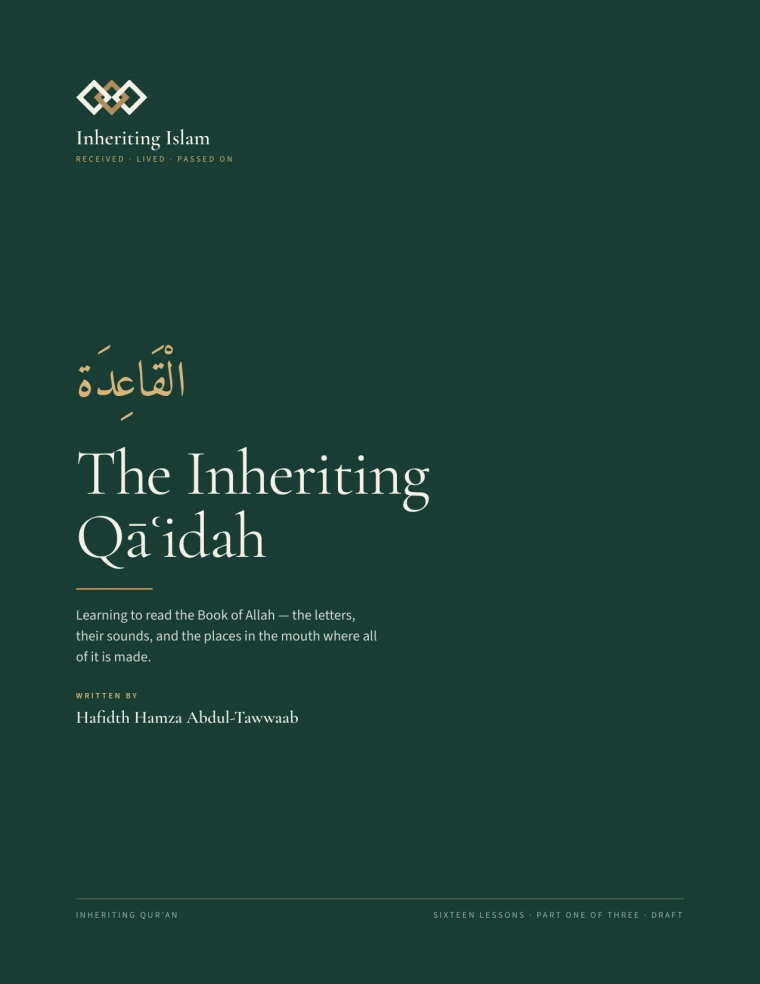
The cover of The Inheriting Qāʿidah: deep pine green, with the house diamond mark in gold, the Arabic title al-Qāʿidah above an English title, and the author's name below.
Book one · reading

The Inheriting Qāʿidah

From not recognising a letter to reading unseen text aloud. Sixteen lessons across the letters, joining, and fluency — then drills, which are most of the book, because a qāʿidah is mostly repetitions.

The drill words are deliberately invented rather than Qurʾānic, so a student who knows Juz ʿAmma by heart has to actually read them instead of recognising them. Every shape in them is one that occurs in the juz; the build refuses to print a join no reader would ever meet.

70 pages16 lessonsPDF · 1.3 MB
The Inheriting Qāʿidah PDF · print ready · free
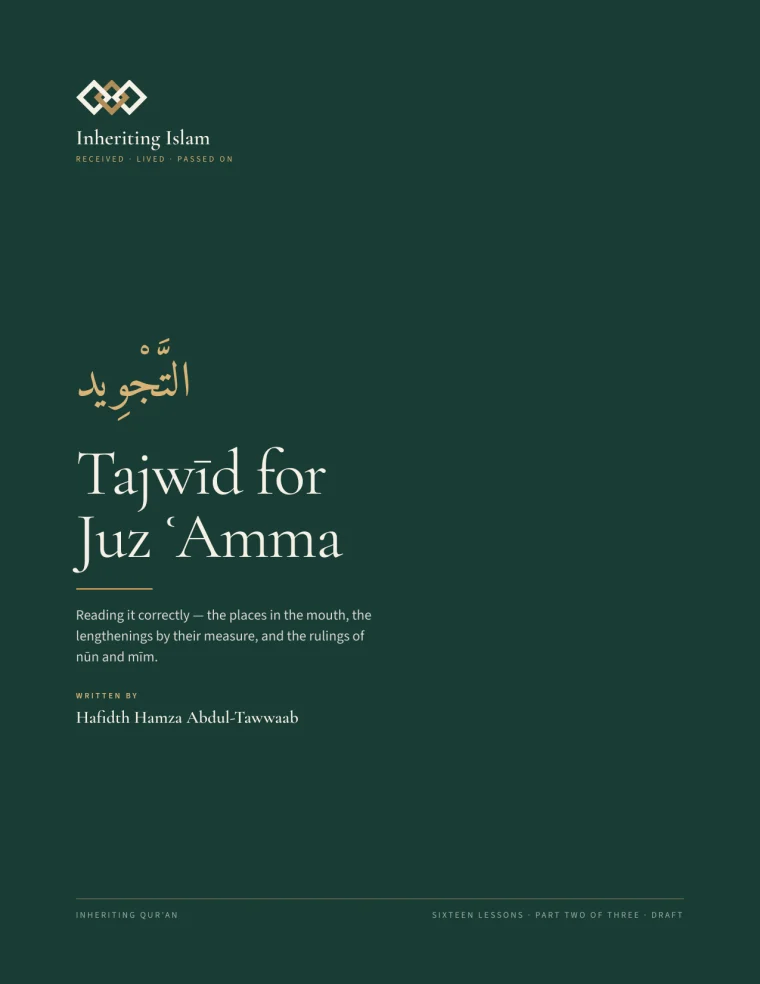
The cover of Tajwīd for Juz ʿAmma, in the same house style: pine green with the gold diamond mark, an Arabic title, and the English title beneath it.
Book two · reciting

Tajwīd for Juz ʿAmma

The mouth, the nose, the lengths — taught as things you do, not things you can name. Scoped deliberately to the thirtieth juz, so every rule is drilled on āyāt you already stand in prayer with.

Its spine is one lesson: the muṣḥaf already tells you the rule. There is no colour coding anywhere in the book, because a student trained on a coloured muṣḥaf cannot apply a single rule in a plain one — which is every muṣḥaf they will ever be handed.

50 pages16 lessonsPDF · 0.5 MB
Tajwīd for Juz ʿAmma PDF · print ready · free
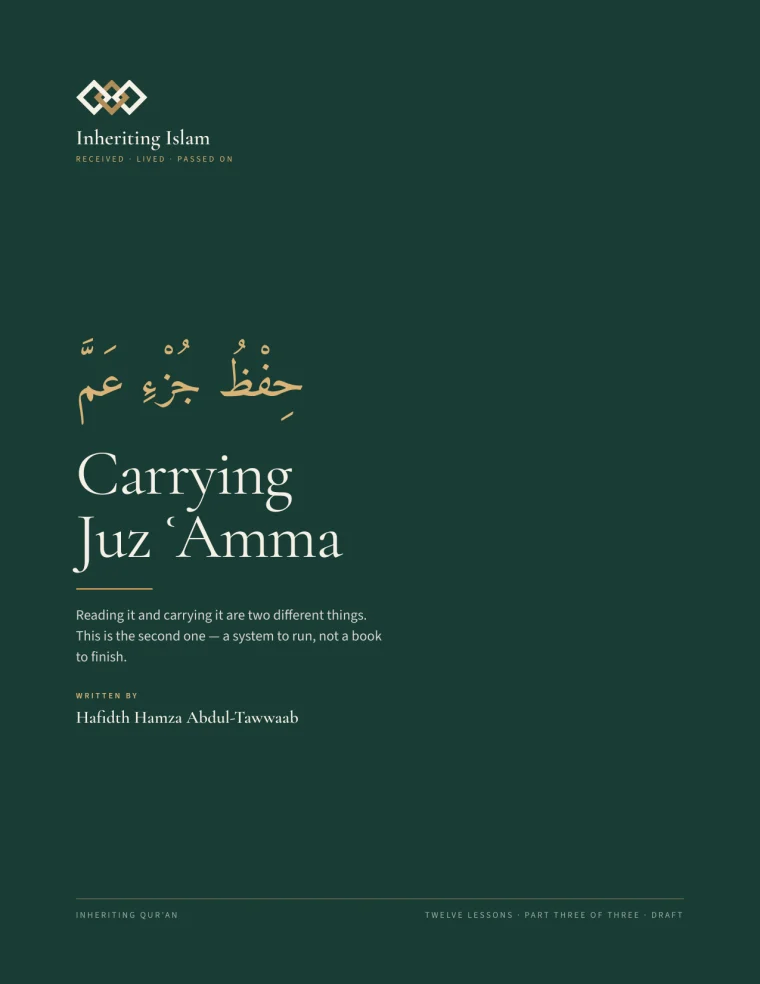
The cover of Carrying Juz ʿAmma, pine green with the gold diamond mark, the Arabic ḥifẓ juzʾ ʿAmma above the English title.
Book three · carrying

Carrying Juz ʿAmma

A system to run for months, not a book to finish. Twelve lessons on how a day is shaped, how much to take on, and what to do on the day you slip — then an apparatus that is most of the book: the whole juz measured, the first word of every āyah, and drills for the four sūrahs that trip everyone.

It ends with a page listing every instruction it gives and where each one came from — settled practice, memory research, or the author's own judgement. Eight of the seventeen are the last kind, and the page says so.

48 pages12 lessonsPDF · 0.9 MB
Carrying Juz ʿAmma PDF · print ready · free
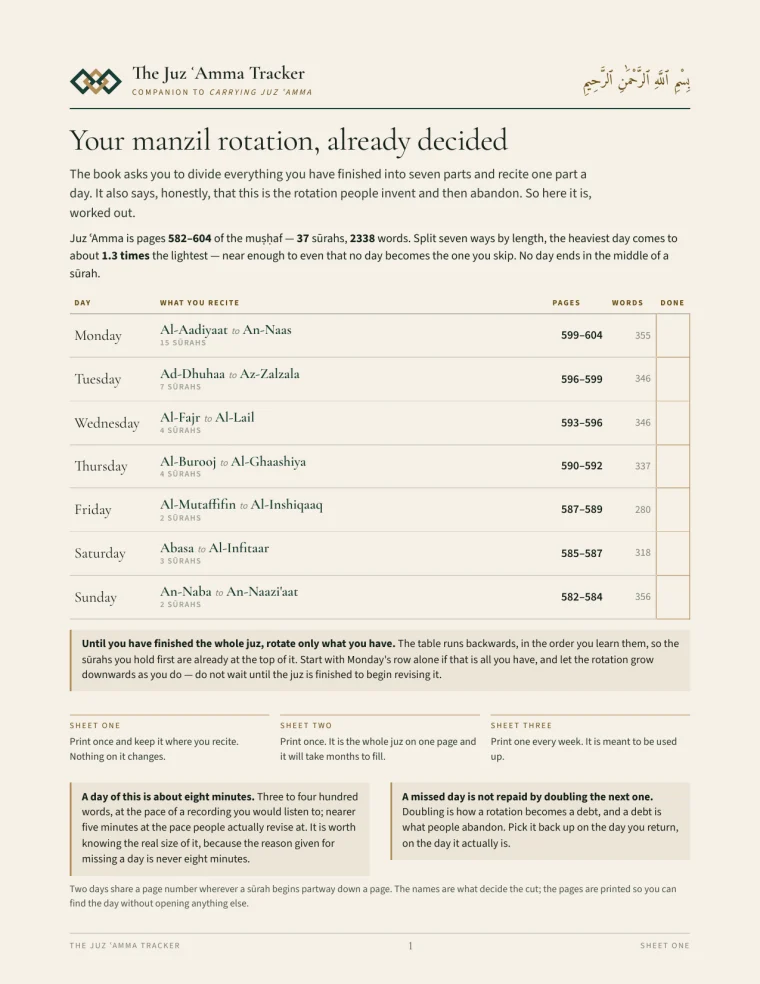
Sheet one of The Juz ʿAmma Tracker: a masthead with the basmalah, then a seven-row table giving each day of the week the sūrahs and muṣḥaf pages to revise, with a box to tick.
Companion · use it daily

The Juz ʿAmma Tracker

Three loose sheets that go with book three. Sheet one divides the juz into a seven-day revision rotation — worked out rather than left to you, balanced by length, and cut so that no day ever begins halfway through a sūrah.

Sheet two is the whole juz on one page with a box for the date each sūrah was locked. Sheet three is one week, and is meant to be used up — print a new one every Monday.

3 sheetsPrint & writePDF · 0.1 MB
The Juz ʿAmma Tracker PDF · print ready · free

How they were checked

An error in a Qurʾān book is not the same as an error in a book.

01

The Arabic is not typed

No Qurʾānic word is written into these books by hand. Every one is referenced by sūrah, āyah and word, and pulled from the Uthmani text at build time — so what is printed is byte for byte what the source says, or the build stops. The qāʿidah drops one mark and says on its own pages which one and why; nothing else is altered anywhere.

02

The order is enforced, not remembered

A drill in lesson six cannot contain a mark taught in lesson nine. That rule is code, not care — the first time it ran it found six places where the book was quietly asking a student to read something it had not taught yet.

03

Nothing ships in the wrong font

Arabic that silently falls back to a system font still looks correct — that is what makes it dangerous. Every character is checked against the fonts actually embedded, and the finished file is checked again for any face that should not be in it.

Free, and that is not a launch offer

These stay free. Print them at home, run them off at the masjid, hand them to a student who will never enrol here. If you teach from them and they help, that is the whole return — the ajr for it is worth more to this house than a price would be.

Attribution is asked for, not enforced: leave the author's name on them.

These are drafts, and say so on the cover. They have been checked mechanically against the text and read end to end, but no cohort has been taught from them yet — and a teaching book is only really proven by a room full of students failing to understand page nine.

If you find an error, in the Arabic or in the teaching, write to Hamza and it will be fixed in the next build. Corrections are wanted, not merely tolerated.

A book cannot hear you read.

That is the one thing on this page that has to be said plainly. These will teach you the shapes, the rules and the method — but nothing on paper can tell you that your ḍād is actually a dāl. For that you need somebody listening, which is what the class is.

Teaching from these at a masjid? There is a page for that — the books are the same ones the sponsored cohorts use, and you are welcome to them either way.