Inheriting Qur'an · received → passed on
Learn to read the Book of Allah, from a person.
Live classes and recordings — reading from the letters up, tajwīd, and memorising Juz ʿAmma — taught by a former imam who led taraweeh long before he built anything. Fifty dollars a month. Recommended by imams who know the teacher.
Cohorts are being formed now. We would rather start small and teach well than open a hundred seats we cannot serve.
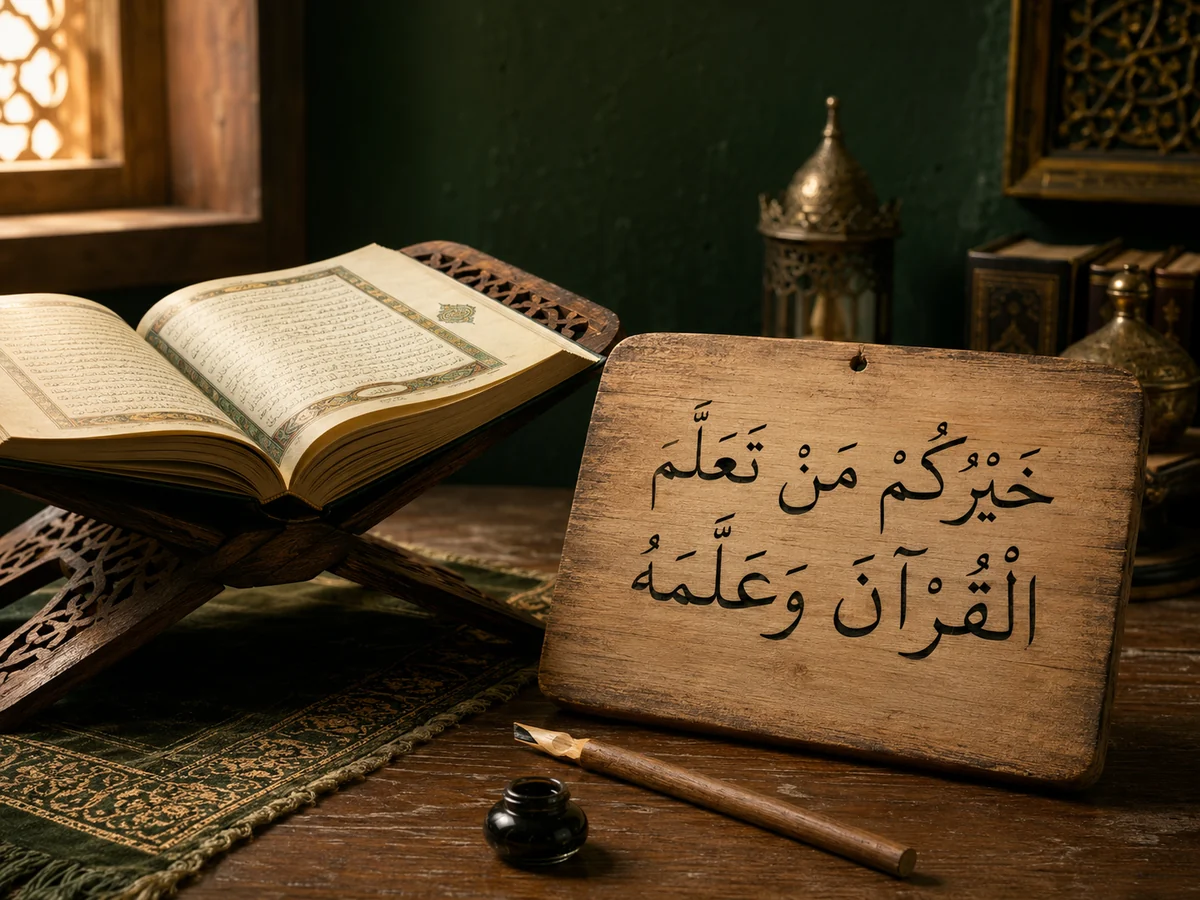
The first word revealed was a command to read. Somebody taught you to pray; somebody should teach you to read.
Who this is for
Adults who were never taught, and are done pretending otherwise.
Reverts. Parents who want to keep ahead of their children. Elders who have prayed for forty years from memory and sound. Anyone in an English-first Muslim community — especially African American Muslim communities — who was handed the deen without being handed the letters.
This is not charity and it is not remedial. It is an inheritance being returned to the people it belonged to the whole time. Nobody here will make you feel late.
The path
From the letters to reading with tajwīd.
You start where you actually are, not where a syllabus assumes you are. Two minutes of Arabic on a page will tell you which of these four you are walking into — nobody sees your answers but you.
- 01
Qaidah — the letters and their sounds
The Arabic letters, where each one is made in the mouth, and the short vowels. Slowly, out loud, corrected in real time by a teacher who can hear you.
- 02
Qaidah — joining and reading words
Connecting letters, long vowels, sukūn, shaddah and tanwīn — until words stop being shapes and start being words.
- 03
Reading fluency
Reading real āyāt, with the basics of where to stop and where to start again.
- 04
Juz ʿAmma and tajwīd
The thirtieth juz — the sūrahs you already stand in prayer with — read properly, with the rules of tajwīd applied rather than recited about.
Where it ends is as honest as where it begins. This is the reading track, and it takes you to Juz ʿAmma read correctly. Two further tracks carry on from there — see below. What none of them is is a full-muṣḥaf ḥifẓ program or an ijāzah track, and if that is what you are looking for we will say so and point you somewhere better.
After the reading
Reading it and carrying it are two different things.
Finishing the reading track does not finish the work. Two further tracks run from there, and a student who already reads well starts in one of them rather than at the letters.
Tajwīd, as its own study
The rules of recitation taught properly and drilled — not recited about, but applied, with somebody listening for whether you actually do it when you are not thinking about it. A basic course to begin with; a fuller one for those who want to go further.
Whether this runs inside the reading cohorts or as a class of its own is still being decided. Either way it is taught, and either way it is included in the same fifty dollars.
Memorising Juz ʿAmma
The thirtieth juz committed to memory — the sūrahs you already stand in prayer with, carried properly rather than approximately.
This is where most people's tajwīd quietly falls apart: rules that hold while reading off a page stop holding the moment the page is gone. So the memorisation is taught with the recitation, not after it.
Neither of these is a full-muṣḥaf ḥifẓ program and neither leads to an ijāzah. If that is what you want, say so and you will be pointed to someone who does it properly.
What each stage ends with
Something to put on the wall.
You were never given anything for this. Most adults who cannot read carry that quietly for decades, and finishing it deserves more than a message saying well done. Each of the three stages ends with a certificate, in Arabic and English, with your name on it in both.
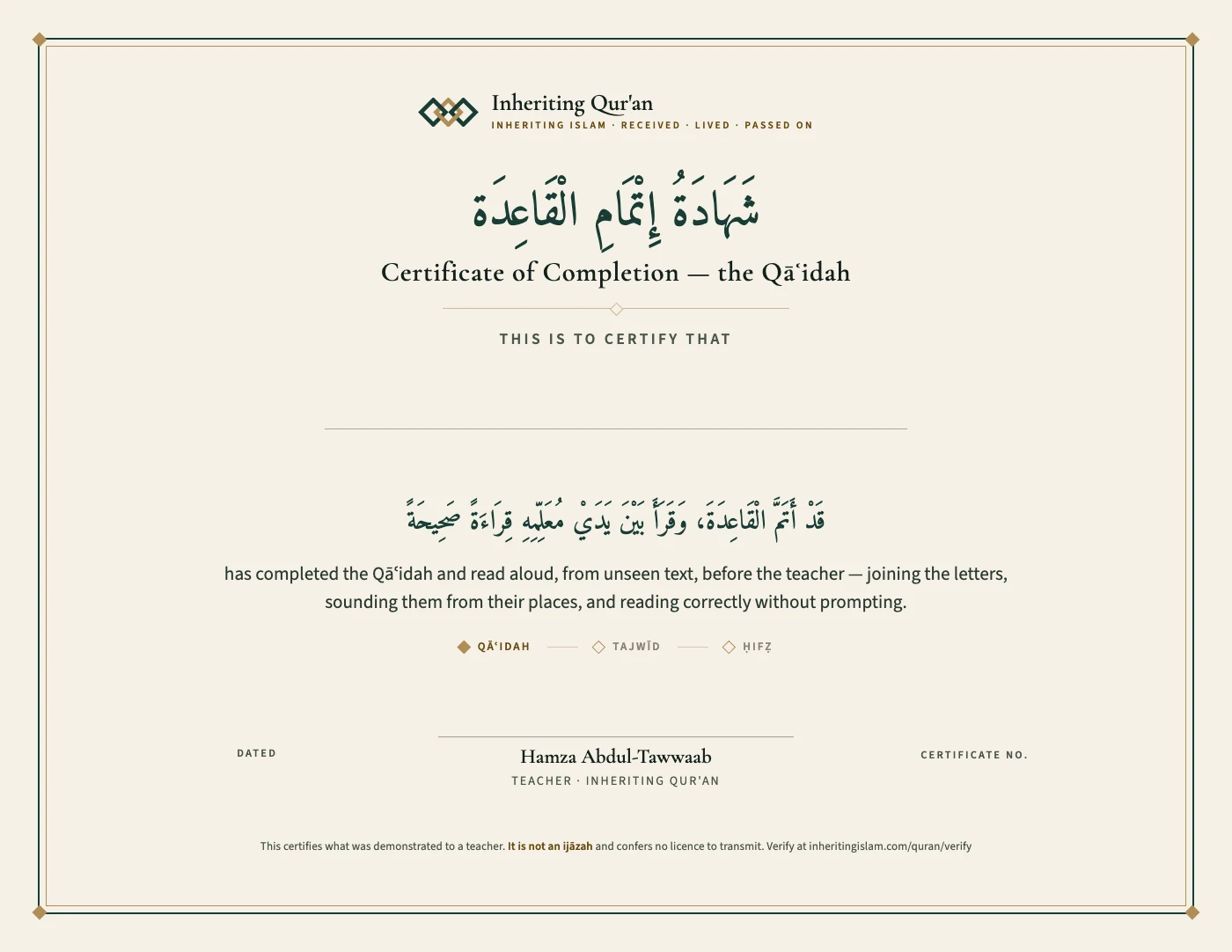
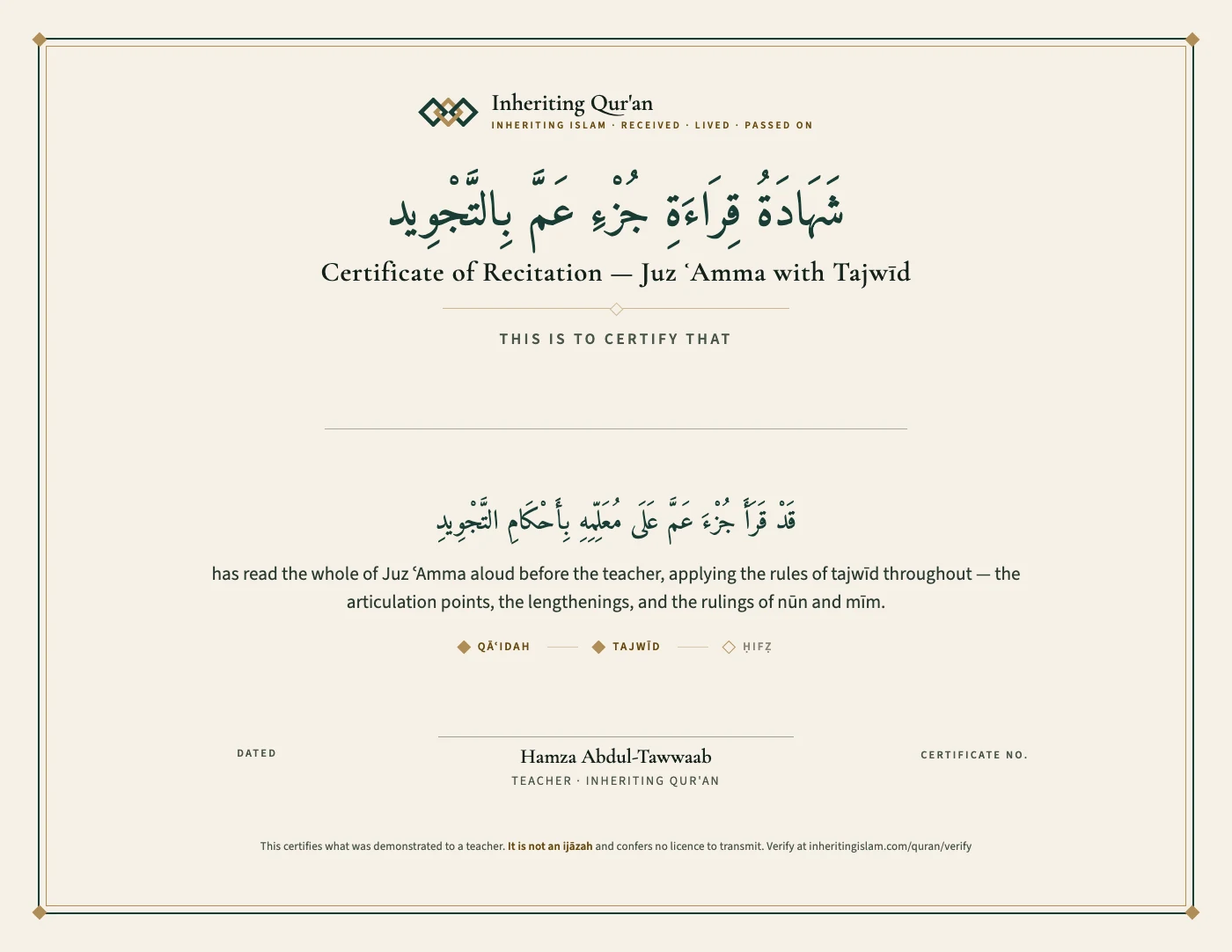
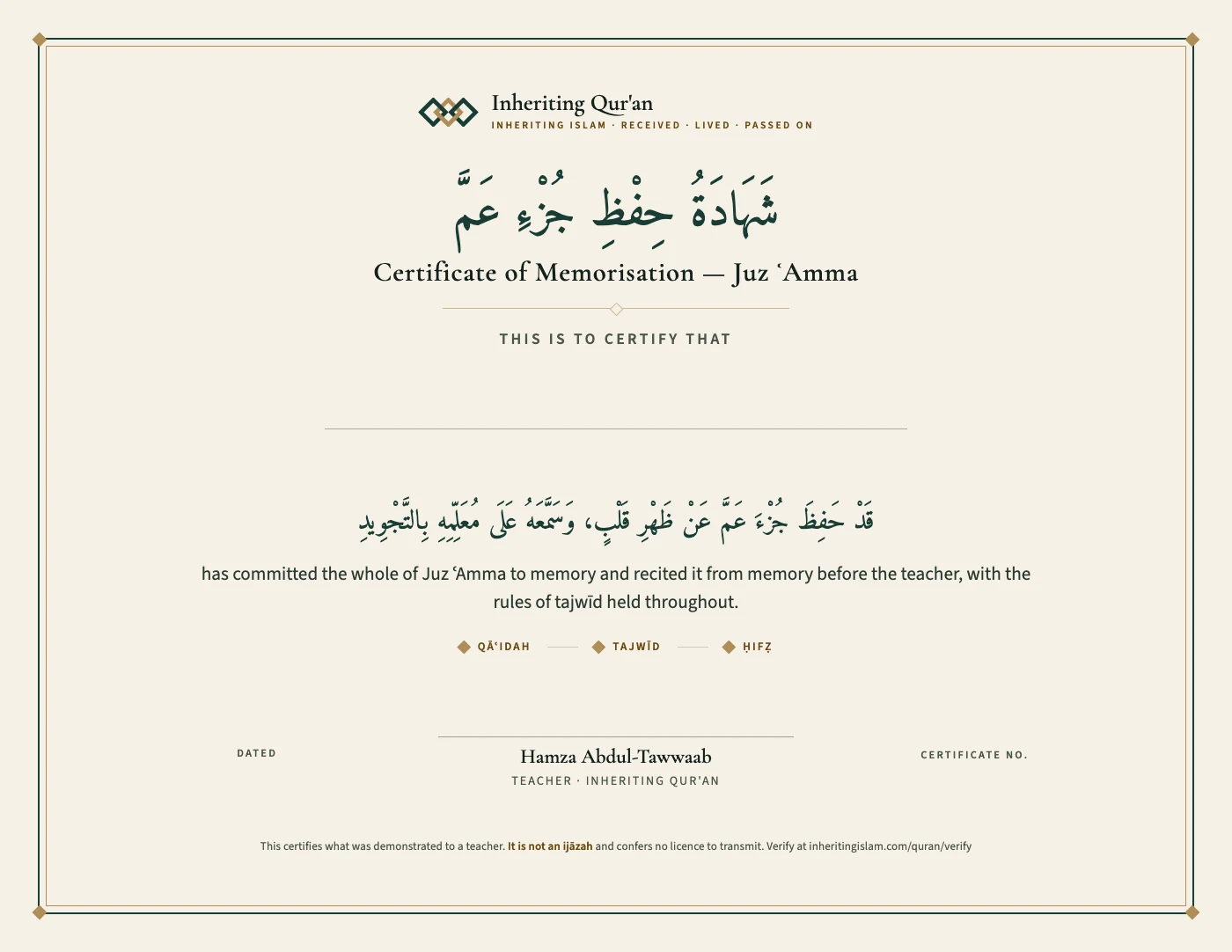
Each one says what was actually demonstrated
Not "attended sixteen sessions". The wording names the thing you did in front of a teacher — read unseen text, applied the rules through a whole juz, recited it from memory. That is the only reason a certificate is worth anything.
Every one carries a number that can be checked at the register, and states plainly that it is not an ijāzah and confers no licence to transmit.
Shown blank, on purpose. These are unfilled specimens and there is no download — a certificate you can download is a certificate anyone can put their own name on.
And none have been awarded yet, because the first cohorts are still forming. The register is empty and says so.
The books
The class has its own books, and they are free.
Almost every reading class in English teaches from the same qāʿidah, and almost nobody teaching from it has the right to reproduce it. So the syllabus was written out instead — a qāʿidah, a tajwīd book scoped to Juz ʿAmma, and a system for carrying it in memory, with a printable revision tracker.
Print them, photocopy them for your students, teach from them without asking anyone. They are the same books these cohorts use.
Three ways in
Before you decide anything, look at the actual thing.
Where do I start?
Five lines of Arabic, easiest first. Read as far as you can and stop — that tells us which lesson you walk into. No score, no email, nothing sent anywhere.
Take the placement checkThe first lesson
The twenty-eight letters, the four shapes each one takes, the three short vowels, and where in the mouth every letter is made. The actual opening of the class, in full.
Sit in on lesson oneCohorts and hours
How a cohort actually runs — size, length, what live and recorded each mean here — and the hours question we have not settled yet, which you can help settle.
See how a cohort runsHow it runs
Live, small, and recorded so you can go again.
- Live sessions in small cohorts, online — so a teacher can hear each student read
- Recordings of every session, to review in the week when the house is quiet
- Taught by Hamza — a former imam who taught Qur'an and led taraweeh across African American Muslim communities
- He has taught at Islah LA in Los Angeles, Midtown Mosque in Memphis, Masjid As-Sabur in Las Vegas, and Atlanta Masjid in Atlanta
- Recommended by imams who know his teaching, not by an advertisement
More about who is teaching you — including what he is not qualified to teach, which is the shorter and more useful list.
Tuition
Per student, per month. Cancel whenever you need to — no term contract, no enrolment fee, no upsell waiting three lessons in.
Why it is priced this low
Teaching a Muslim to read Qur'an is not a business opportunity. The fee covers the teacher's time and keeps the class serious on both sides — nothing more.
And the fee is the default, not the gate. There are sponsored seats, reduced rates, and masajid who cover students from their own community. The form below has a box for exactly this — tick it and we will sort it out on the call.
Nobody here needs you to explain your finances to be taught to read.
Why a person, when we also build software
This house builds apps, and we still teach this with a human ear. Recitation has always needed one: someone who can hear that your ḥāʾ is a hāʾ and stop you on the spot.
Software can drill you, remind you, and keep your streak. It cannot correct your mouth. We are not going to pretend a microphone is a teacher in order to make this arm scale.
Private seats
One to one, for the few who need it.
Some students cannot make a fixed weekly hour, some are further along than any cohort forming right now, and some simply learn faster with nobody else in the room. For them there are a small number of private seats.
This is expensive on purpose, and the reason is worth saying plainly. The group class is fifty dollars and it is the same teacher, the same syllabus and the same correction. What the private rate buys is not better teaching — it is an hour that cannot be given to anyone else.
It is also what pays for the sponsored seats. The full-rate work carries the khidma work here exactly as it does everywhere else in this house.
Weekly, one to one
A standing forty-five minute session each week, at an hour agreed with you. Recorded, like everything else, so you can go over it again.
A single session
One forty-five minute session, not repeating — to be placed properly, to fix one thing, or to see whether this is for you at all.
Three at a time, and that is the real number
Hamza teaches around a full-time job and everything else in this house. Three standing private students is what can be done properly rather than what could be sold.
When they are taken they are taken, and you will be told that rather than added to a list quietly. If a cohort would serve you just as well, we will say so — that is two hundred and seventy dollars a month we are talking you out of, and it is still the right advice.
For masajid
Bring a class to your community.
If your masjid has adults who want to read and no one with the hours to teach them, we can run a cohort for your community — announced by you, taught by us, and yours to keep promoting. There is no fee to host, and many masajid sponsor a handful of seats for families who would not otherwise enrol.
What we ask of a host masjid
Announce it to your community, give us one point of contact, and let us know honestly what your people need. That is the whole ask — there is no fee to host.
What you get back is a cohort of adults in your own congregation who can read, and who will teach their children.
Enrol
Tell us where you are starting from.
Six answers, most of them one line. It opens your own email app so you can see exactly what is being sent — nothing is submitted to anyone else.
On the cost, plainly
Fifty dollars a month is what the class costs. It is not what you have to have in order to be taught.
Sponsored seats exist, reduced rates exist, and masajid sponsor students from their own community every term. That is why there is a box for it above rather than a paragraph asking you to write in and explain yourself.
Why we ask about your masjid
Three reasons, and none of them is checking up on you. It tells us which communities our students come from, it lets a masjid sponsor a seat if they already do that, and if your imam knows Hamza it saves everyone a conversation.
Leave it blank if you would rather. It has never been a requirement.
Or reach us directly
- Email hamza@inheritingislam.com
- Phone (470) 404-0648